Cdo awaits you at the Rimini Meeting 2026
PAVILION C1
This year too, Cdo will be present at the Rimini Meeting with a space designed to welcome and showcase profit, educational, and social organizations. It will be a particularly significant edition because it coincides with the 40th anniversary of Compagnia delle Opere: an anniversary that is not meant to be merely a celebration, but an opportunity to tell a living story, made up of works, businesses, people, and communities that every day build in local areas.
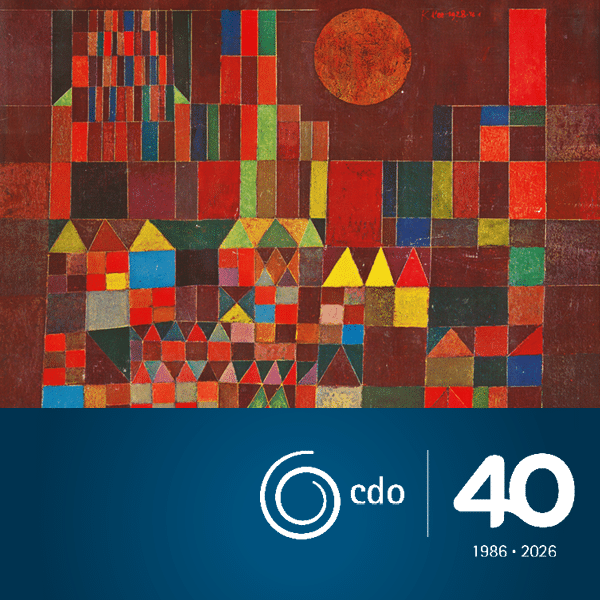
The image chosen to represent the Cdo pavilion, Paul Klee’s 1928 work “Castle and Sun”, expresses this outlook well: a city that grows as it takes shape, brick by brick, according to a shared design. Not a city already complete or crystallized, but a positive, harmonious, and everyday construction, the result of the effort of many.
This is the experience that Cdo wishes to offer at the Rimini Meeting: a space to inhabit, in which each person can live the week in an active and participatory way, encountering experiences, projects, and activities that take shape during the year in reality.
Cdo’s presence at the Rimini Meeting will be marked by several themes: the Manifesto of the 40 years, Pope Leo XIV’s encyclical “Magnifica Humanitas”, with a specific focus on the theme of work.
The journey will be structured through several large thematic spaces:
The Square of Works
A living crossroads of social, entrepreneurial, and educational testimonies, expressing the world of profit and non-profit, designed to show the value of concrete, generative industriousness capable of building the common good.
The Cdo Arena
A space for public meetings with national and international guests — entrepreneurs, educators, public managers, representatives of institutions, researchers, innovators, and protagonists of civil society — to give voice to stories and ideas capable of reading the challenges of the present and imagining the future.
The exhibition “Léon Harmel, the Prophecy of a Business”
A journey dedicated to the French industrialist who, as early as the 19th century, intuited and realized a conception of work based on the dignity of the person, worker participation, and a welfare system capable of embracing the whole of life.
Alongside these spaces, there will also be informal meeting moments, interactive activities, and corners dedicated to discovering the world of Cdo, designed to make each person an active part of a community that places the person at the center, work as vocation, and the building of more humane places.
The participating organizations will be: Aslam, Associazione Il Rischio Educativo, Avsi, Banco Alimentare, Banco Farmaceutico, Banco dell’Energia, Diesse, Disal, Economy, E-Work, Famiglie per l’Accoglienza, Federazione Centri di Solidarietà, Fondazione Progetto Arca, Portofranco, Subsidium, Ucid.
Also present in the institutional space will be the National Secretariat of Cdo, Cdo Opere Sociali, Cdo Opere Educative (FOE) and Cdo International.
THE HUMAN AT THE CENTER. SCHOOL IN MOTION
BEYOND ADDICTION. THE POWER OF RELATIONSHIPS
GOVERNANCE IN COMPLEX HEALTHCARE SYSTEMS
CHRISTIAN PROTAGONISM IN THE WORLD IN THE FACE OF THE TWILIGHT OF DEMOCRACY IN LATIN AMERICA
WELFARE IS NOT A BENEFIT. BUSINESS, PERSON, WORK
LÉON HARMEL: “MY TRUE VOCATION IS TO FORM PEOPLE”. THE MEANING OF WORK
BUILDING NETWORKS FOR DISABILITY
RENEWING THE SCHOOL BY GUIDING ITS CHANGE
LÉON HARMEL: “MY TRUE VOCATION IS TO FORM PEOPLE”. THE WORKING ENVIRONMENT
THE AUDACITY OF ORIGIN: WHEN INNOVATION IS BORN FROM WHAT WE HAVE RECEIVED
HOUSING, A PRIVILEGE FOR ALL
LÉON HARMEL: “MY TRUE VOCATION IS TO FORM PEOPLE”. FRIENDSHIP AT WORK
GENERATIVE ENTERPRISES: SOCIAL SUSTAINABILITY AT THE BASIS OF COMPETITIVENESS
THE LINK BETWEEN ENERGY AND ARTIFICIAL INTELLIGENCE: COSTS AND BENEFITS
SPORT AS A HARMONIOUS PATH
CAN THE INTERSECTION BETWEEN THE CAPITAL MARKETS, PRIVATE EQUITY AND BUSINESS LEAD TO POSITIVE OUTCOMES?
TEACHING AS A PROFESSION: THE TEACHER AS THE PROTAGONIST BETWEEN BUREAUCRACY AND FREEDOM OF TEACHING
THE CHALLENGE OF INTEGRATING
INTEGRAL HUMANISM AND CIVIL ECONOMY