August 2026
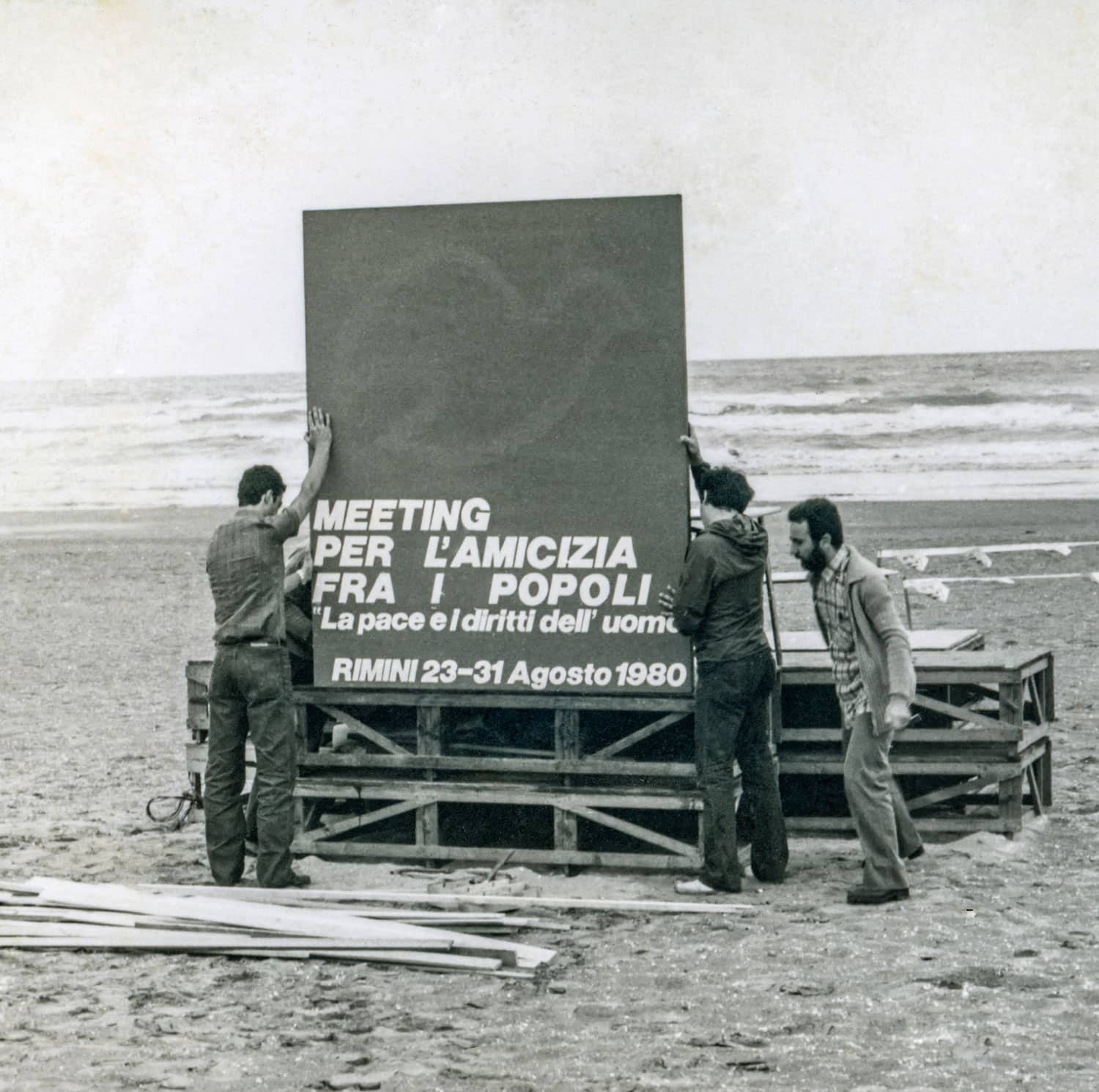
The bond between the Holy See and the Meeting for Friendship amongst Peoples is deeply rooted in time and marked by a series of events that have unfolded over the years, shaping the history of the event. This relationship will enter a new, extraordinary chapter on the afternoon of 22 August, with the eagerly awaited visit to the Meeting by Pope Leo XIV. The event forms part of a continuous tradition of support that has lasted for over forty years and has involved three different popes.
Papal messages: an unbroken tradition since 1980
Ever since the first edition in 1980, without exception, the Popes have sent their messages to the Meeting every year. These words have consistently provided essential insights into the event’s theme, guiding the work of the volunteers and the reflections of the participants, as also evidenced by the message sent by Pope Leo XIV for the 2025 edition. In keeping with tradition, Pope Leo has also featured in the title of this year’s Meeting (“In the deserted places we shall build with new bricks”), inviting us to “dare to be prophetic, allowing ourselves to be drawn into the desert and to see, even now, what may arise from the rubble and from so much, far too much, innocent suffering”.
Saint John Paul II: the ‘civilisation of truth and love’
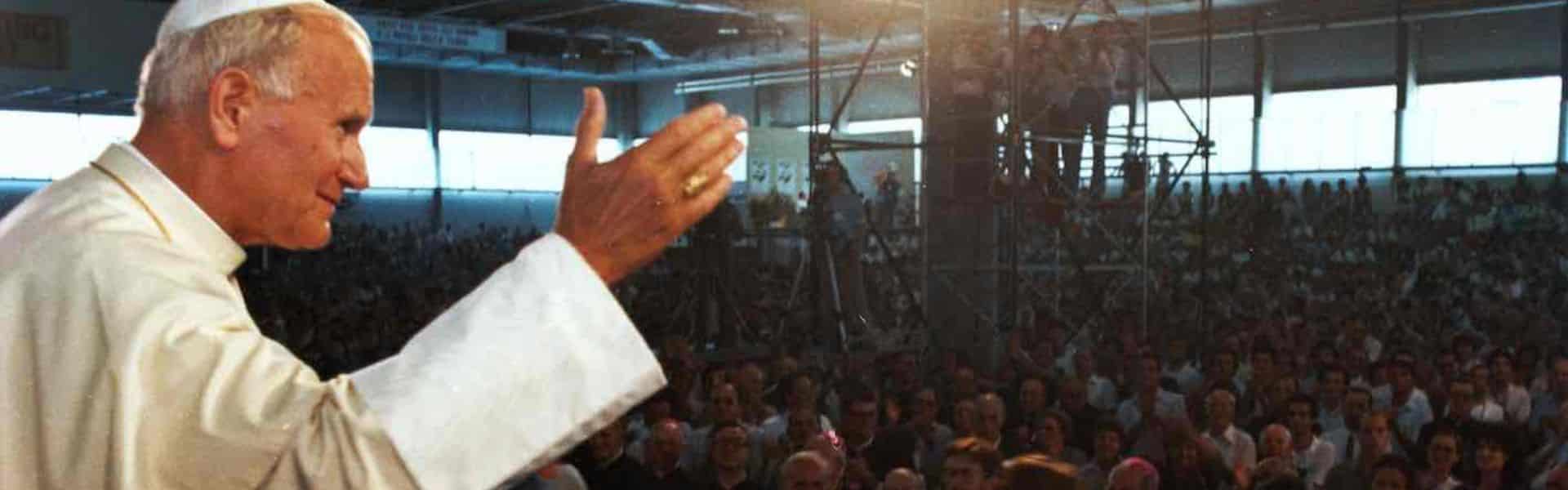
One of the milestones in this history is Saint John Paul II’s memorable visit to the Meeting on 29 August 1982. In that famous address, the Pope charted a course that still guides the event today.
The appeal that Pope Wojtyla made from the auditorium of the old exhibition centre was stirring: ‘Peace today is seriously threatened; science and technology risk creating an imbalance fraught with negative consequences in the relationship between human beings, between human beings and nature, and between nations. Faced with this contradiction, which seems unstoppable because it is structurally linked to the mystery of evil, we must turn our gaze to ‘the author of our salvation’ in order to bring forth a civilisation born of truth and love. The civilisation of love! So that we may not languish, so that we may not wither away in unbridled selfishness, in blind insensitivity to the suffering of others. ‘Brothers and sisters, build this civilisation without ever tiring!’
In the summer of 1991, during a gathering at Castel Gandolfo that included Mass and lunch with the Pope, some organisers of the Meeting had the opportunity to speak with John Paul II. It was then that the Pontiff, recognising the uniqueness of the Meeting, uttered a phrase destined to be remembered: ‘You are creating a culture of the frontier.’
Pope Wojtyła provided another deeply moving moment on 22 August 2004, when there was a live link with the Holy Father at the end of the Holy Mass celebrated in Rimini, presided over by the then Bishop Mariano De Nicolò and broadcast on Rai 1. After greeting Don Luigi Giussani, who like him was seriously ill (both would leave this world the following year), John Paul II recalled that “Christianity, despite human limitations and errors, constitutes the greatest factor in true progress because Christ is an inexhaustible source”.
Cardinal Joseph Ratzinger: “A community always in need of reform”
Although he never visited the exhibition halls of the Fair in his capacity as Pope, Joseph Ratzinger was one of the Meeting’s key figures. On 1 September 1990, the then Cardinal and Prefect of the Congregation for the Doctrine of the Faith delivered a historic address entitled ‘A community in constant need of reform’. It is a text of such depth and relevance that it has been quoted on several occasions by his successor, Pope Francis.
In his address at the Meeting, Cardinal Ratzinger addressed the theme of the Church’s renewal, moving beyond the prejudices that reduce it to a mere stifling institution. The Cardinal rejected proposals for reform based on activism or purely democratic logic, which risk transforming faith into mere opinion and the Church into a self-made human construct. True reform, on the other hand, is defined as ‘ablatio’, that is, a work of purification which removes human superstructures to allow the authentic image of God and the essential to shine through. This journey requires an openness to the Eternal One through faith, the grace of forgiveness and the capacity to embrace suffering, finding true guidance in the Saints.
That same day, Ratzinger held a press conference, engaging in an open and lively dialogue with numerous journalists.
Pope Francis and the key figures of the Meeting
Pope Francis, whilst faithfully continuing the tradition of papal messages, granted an audience at the end of the event to some of the witnesses and key figures who have brought the various editions of the Meeting to life. Among these were his meeting with Father José Maria ‘Pepe’ di Paola (at Santa Marta on 24 August 2013) and the moving encounter with two fathers, the Israeli Rami Elhanan and the Palestinian Bassam Aramin, who lost their daughters to terrorism and military occupation, accompanied by the writer Colum McCann, who made them the protagonists of his novel Apeirogon.
Pope Leo XIV and the 2026 Meeting
Pope Leo XIV’s visit to the Rimini Meeting (scheduled for the afternoon of 22 August 2026) marks the culmination of a process of intense dialogue that began in recent months.
Once again, it is the writer Colum McCann (a long-standing friend and guest of the Rimini event) who will accompany Diane Foley – the mother of journalist James W. Foley, who was kidnapped and killed by ISIS – to meet Pope Leo XIV on 26 August 2025.
On 26 January 2026, the Holy Father received Bernhard Scholz, president of the Meeting Foundation, in private audience. On that occasion, the invitation to Rimini was formally renewed. ‘I am very grateful to have been able to explain to the Holy Father, in a very cordial atmosphere, the nature of the Meeting and the reasons behind our commitment,’ Scholz stated at the time.
That joy turned to anticipation on 19 February, when the visit was officially confirmed. “We are already experiencing great joy as we look forward to welcoming and listening to the Holy Father,” commented President Scholz. From the very beginning of his pontificate, Pope Leo has invited us to build places of love, peace and reconciliation: his visit makes us even more aware of, and responsible for, what the Meeting – as a place of encounter and sincere dialogue in the search for truth, beauty and justice – represents for the hundreds of thousands of visitors and for the volunteers and staff who take part in it.”
Finally, to give a preview of the themes of the meeting and the Pope’s vision for international dialogue, on Wednesday 18 March the exhibition ‘Called Twice. The Martyrs of Algeria’ was presented to Pope Leo XIV on Wednesday 18 March, shortly before the Holy Father’s departure on his apostolic journey to the North African country on 13 April. This is a further step confirming the Meeting’s profound universal scope, now ready to welcome the Successor of Peter.