Who we are
“EVERY MAN TO HIS WORK”
Questions and Experiences Starting from the Manifesto of Good Work

Guided tour duration: 45 minutes
Exhibition promoted by Compagnia delle Opere
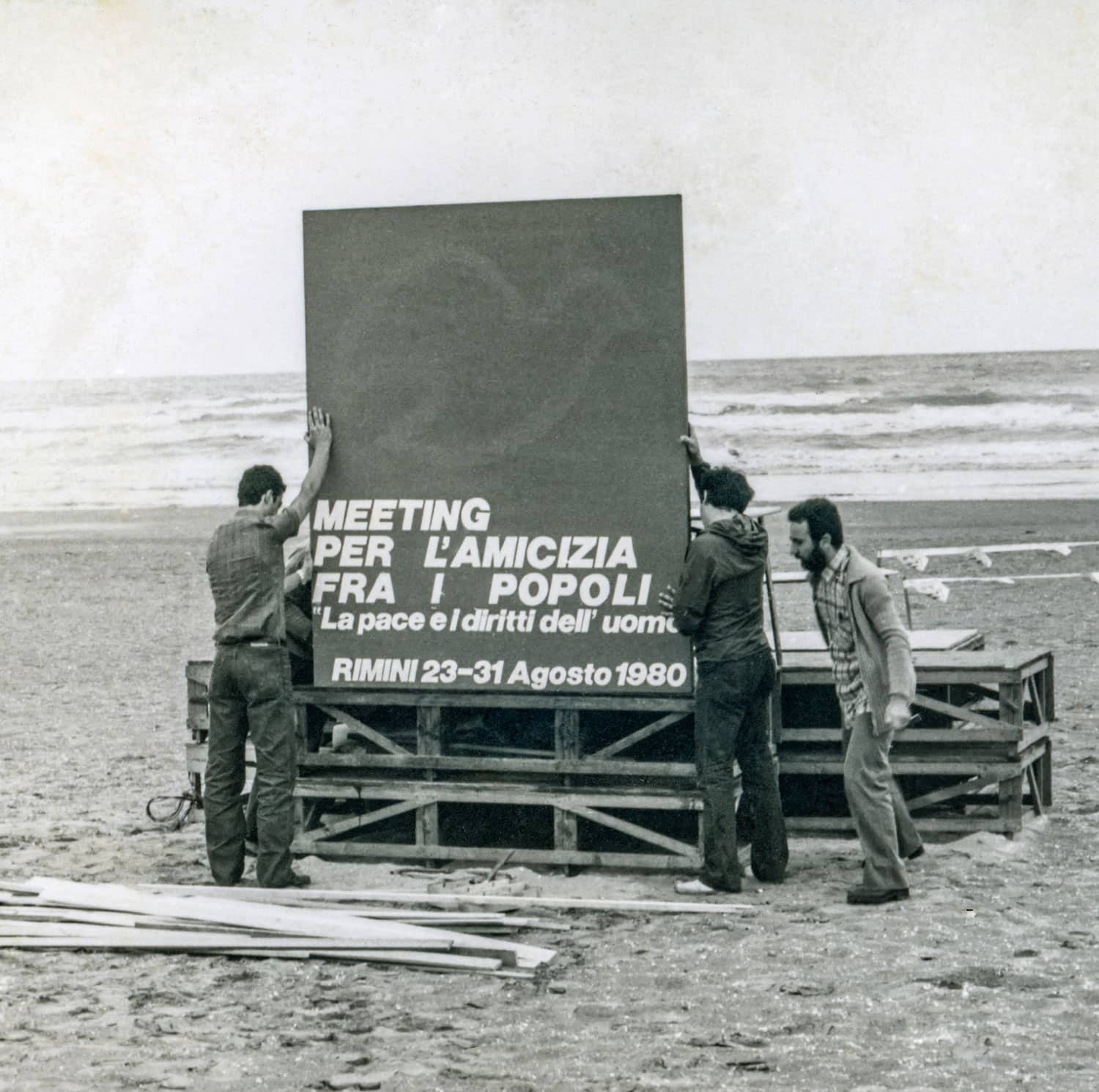
“Each man to his job.” This is how the passage by T.S. Eliot ends, the same passage from which this year’s Rimini Meeting takes its title. It is no surprise, then, that the theme of work is one of the main focuses of this edition.
Last year, the Meeting provided the opportunity to complete the reflections that led to the drafting of the Manifesto of Good Work, later disseminated by the Compagnia delle Opere in dozens of events across Italy. This document was not intended merely to outline programmatic points, but to spark a process of analysis, dialogue, and comparison among entrepreneurs and with all people and institutions interested in rethinking the meaning of work today.
This year’s edition takes a step further with an exhibition that bears the same title as Eliot’s concluding phrase and emerges as a “natural” development of the Manifesto.
Its starting point is that work still today raises countless questions for those who do it or seek it. At the same time, even though the volume and intensity of work are increasing, satisfaction and happiness among workers are declining, as national and international research continuously shows.
In such an urgent and widely debated context, this exhibition aims to be a space where the questions anyone working might face can be asked and encountered, bringing them into dialogue with experiences of those who have attempted, in practice, to respond. How? By comparing with the experiences and insights of entrepreneurs, managers, employees, professionals, and non-profit entities, both Italian and international, of different ages. These will be shared through brief video interviews.
The exhibition is divided into three sections: background context, key questions, and testimonies, built around themes particularly urgent today that touch on the different facets of the meaning of work.
The first section is about working for what and for whom. The theme of purpose is increasingly central for many organizations, but often simply stating a purpose is not enough for workers to identify with it. This can be explored from both the company’s and the worker’s perspective. What is the purpose of my work? Should my personal purpose align with that of the company I work for? Not just why do I work, but for whom do I work?
The second section explores working with. Work means relationships — with colleagues and with the broader reality in the form and task each person is called to. Work is always about coming together. This raises the issue of encountering the diversity of others. What value does listening to others have in a company? What value lies in building mature and deep relationships at work?
But also: what does working in an office mean today? What does it mean to work from home? What are the advantages of working in a shared space? What are effective organizational models for smart working?
In a context where, according to Gallup, only 13% of Italian workers feel a sense of belonging at work, and Censis reports that 20.5% often and 48.1% occasionally feel their work environment does not foster cohesion among colleagues, these questions are more urgent than ever.
The final section addresses working how, starting from the observation that certain intrinsic and very concrete aspects of work raise fundamental questions about its meaning.
Take fatigue, for example: between 2013 and 2023, the number of workers resigning annually increased by 57%. Between sacrifice and exhaustion, work often seems detached from life. This raises many questions: Is the goal of working to find a balance between life and work? This idea is often criticized—but what is a constructive alternative today? Are life and work inevitably in conflict? Is it a matter of organizational tools or of deeper purpose?
Technology, particularly artificial intelligence, also plays a role: what kind of opportunity does it offer workers today? Is it merely a way to reduce work time, or can it improve how we work and free time for better activities?
More deeply, how do we face the demands, pace, and performance pressures of work? According to Censis, 24% of Italian workers often feel under too much pressure, and 49.9% occasionally. How does the legitimate desire to work well turn into a performance trap? Is performance always negative, or can it be directed toward a greater design?
This exhibition engages these questions with experiential responses from people who seriously face them every day — because the greatest illusion is to think we can answer alone, or worse, to believe we are the only ones asking.
Not a definitive answer, but a contribution to a shared judgment to place the meaning of work back at the center and begin a new journey — together.