29 May 2026
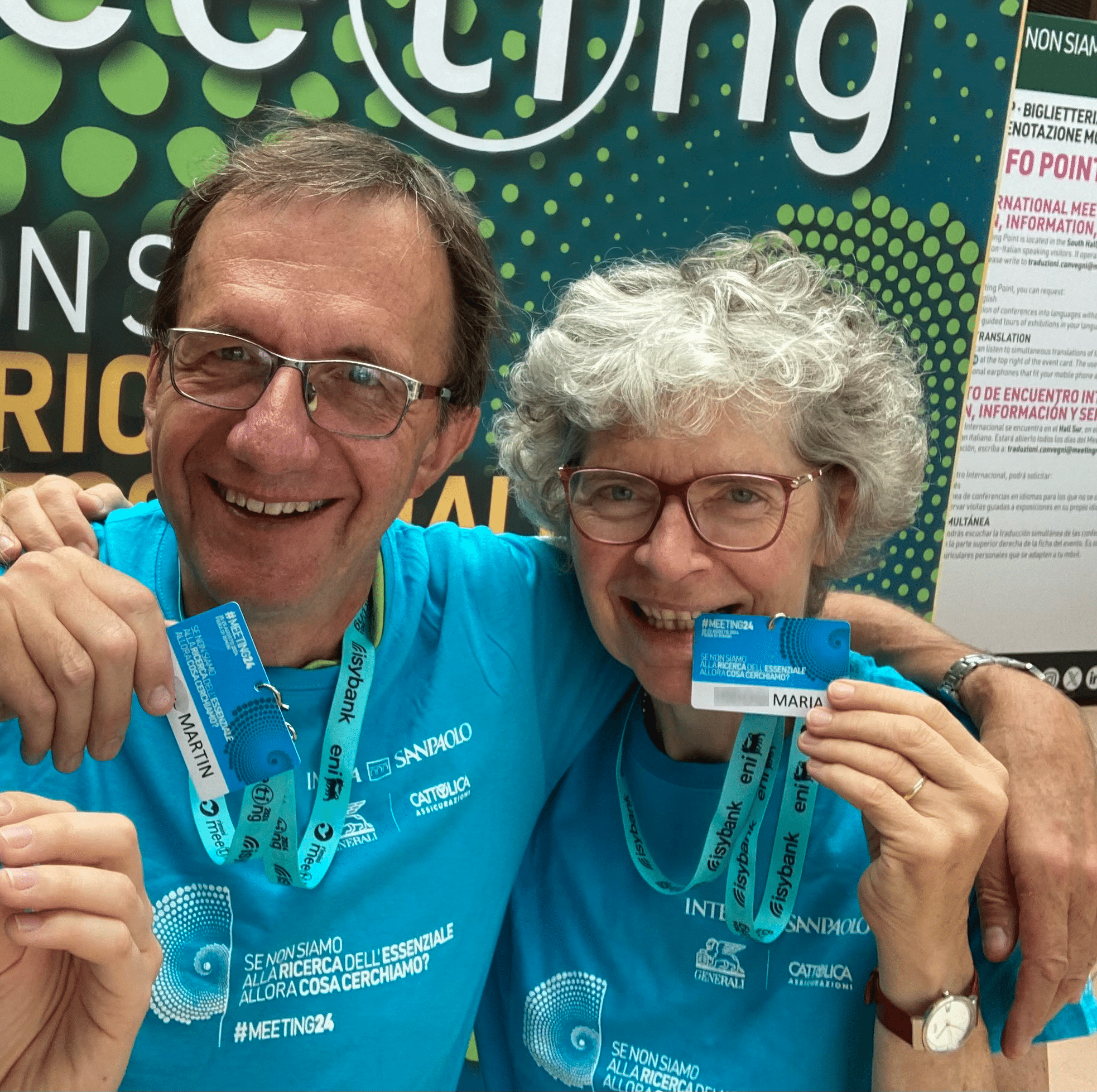
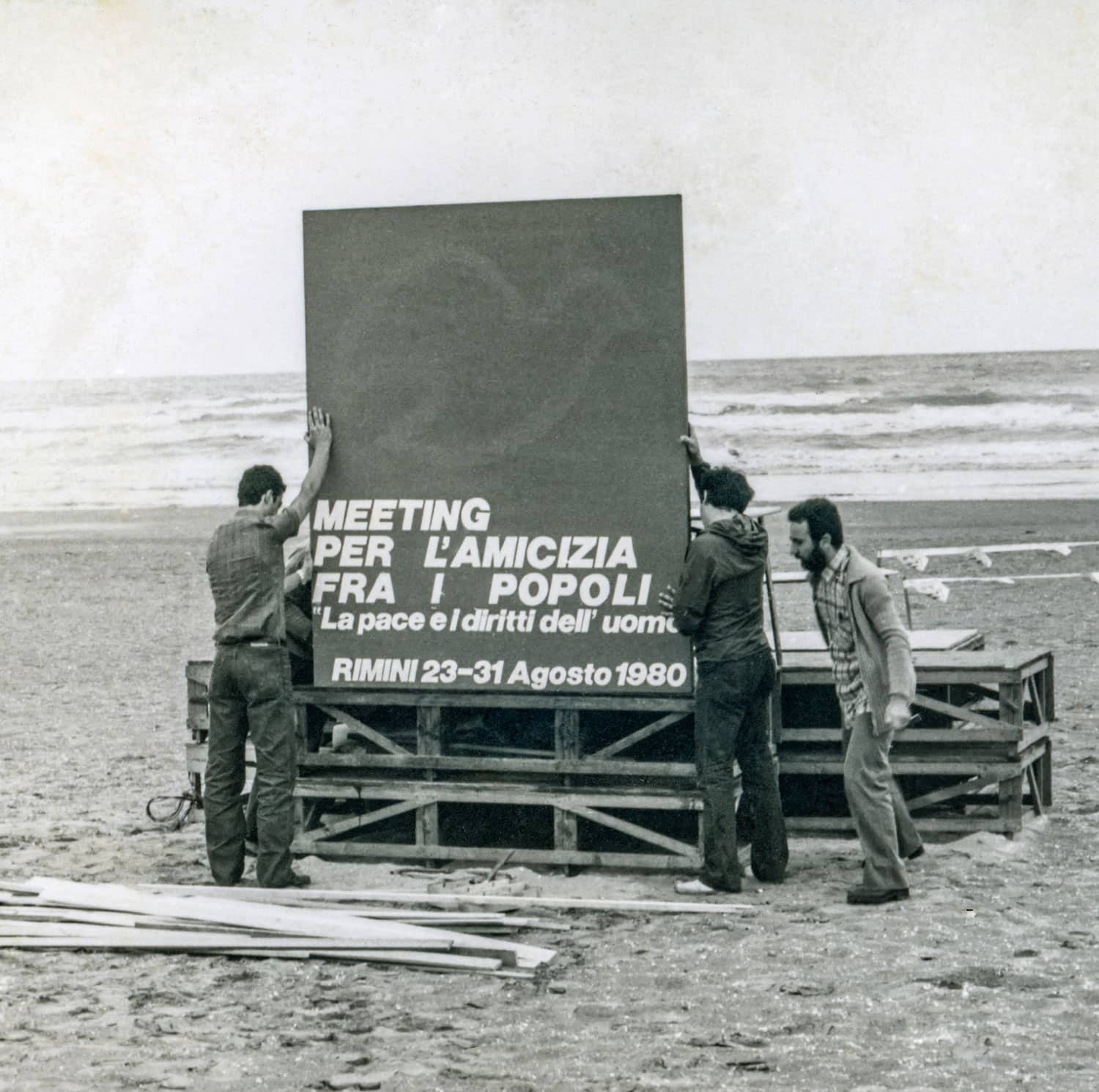
The Meeting touches the heart and changes the way we look at our relationship with others. This is what Martin and Maria from Eichstätt carry with them after many years of taking part. He, former director of the University of Eichstätt, has been attending the Meeting since 1982; she, a pharmacist, came for the first time in 1983. It was an encounter that left an indelible mark.
Maria still remembers the exhibition dedicated to Tarkovsky: “I spoke very little Italian and the exhibition was in English. I was deeply struck by the way Tarkovsky’s work revealed his deepest human desire: truth, justice and beauty.” She tells us that it was a real discovery for her: “At school they had told us that there is no connection between an artist’s work and the artist as a person. At the Meeting I learned the opposite.” From that moment, she understood that this would be her place. Martin and Maria therefore began working at the International Meeting Point, doing translations.
For Martin, the Meeting is something unique, capable of welcoming everyone: “It gives you an impulse to explore the questions of the heart more deeply.” And he adds: “The beautiful thing is that it is a secular environment.” From the very beginning, he was struck by the volunteers, “people from different backgrounds, with a deep faith and joy, ready to serve in any circumstance.” Looking back on last year’s exhibition on Carlo Acutis, Martin recalls an episode that deeply impressed him: their guide was Muslim and spoke about “his inner struggle with Acutis’s hypothesis of life.” It was yet another confirmation that the Meeting “is not a closed place, but opens itself to all those who have a human heart.”
The joy experienced during the days of the Meeting does not end with the event, but continues in daily life. “Such an experience fills the heart and sustains my day,” Maria says. In Eichstätt too, Martin and Maria continue to keep the experience of the Meeting alive through exhibitions. The one dedicated to Franz and Franziska Jägerstätter was very positively received both by the local community and by the diocese. They also remember with gratitude the exhibition on Takashi Nagai, “Announcement from Nagasaki,” which was brought to 18 German-speaking cities in Germany, Austria, Luxembourg and Switzerland.
In today’s difficult international context, the Meeting represents a light. “In a time when power seems to dominate everything, the Meeting is a concrete, not utopian, hope,” Martin observes. Here one discovers “a hidden strength: a love that is not sentimental, that leaves man free and at the same time attracts him.” A strength truly capable of changing reality. For Maria, at the Meeting one can see that “the Church is communion”: a presence capable of proposing a path that does not stop in the face of difficulties. Through the many realities represented at the Meeting, one understands how “love, reconciliation and forgiveness can become decisive factors for coexistence even among people who would otherwise be enemies.”
For all these reasons, the Meeting deserves to be supported. Because the event, Maria concludes, “is a work built by a people.” Year after year, the Meeting continues to generate places of encounter and hope, which the world today deeply needs.