August 2026
Riscoprire la potenzialità dell’umano nel tempo dell’efficienza tecnocratica. Il linguaggio, la coscienza, il limite biologico, sono elementi caratteristici dell’essere umano.
The meeting in Rimini
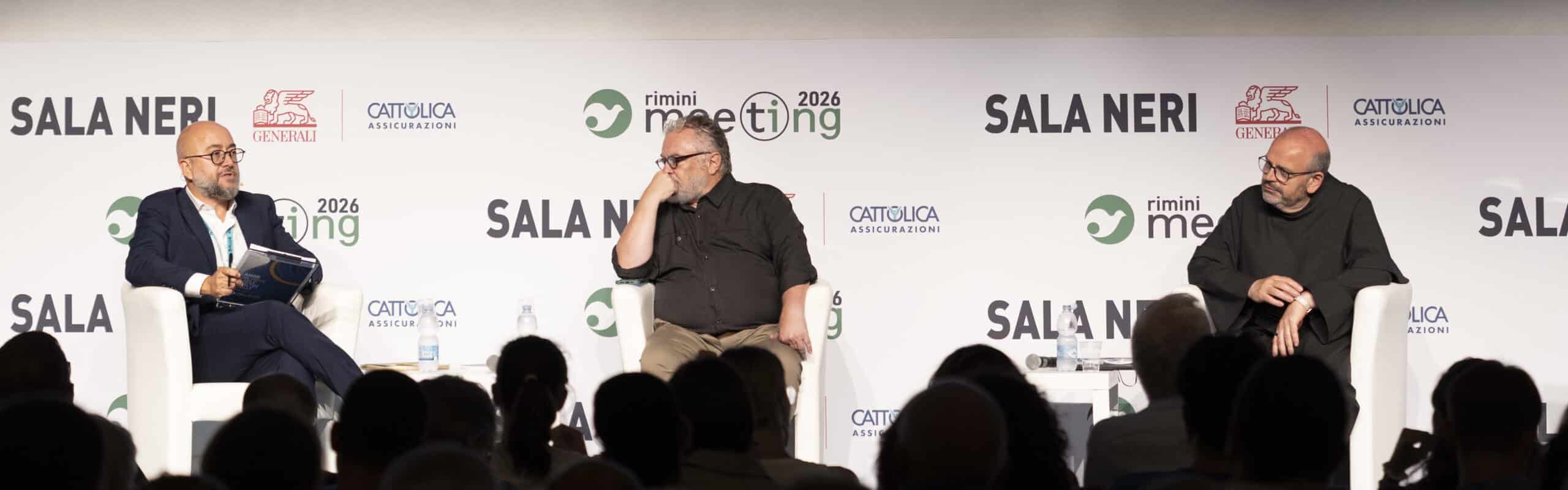
These were the themes at the heart of the session «Words, machines, brains: recognising what is human in order to defend it», held in Rimini on 23 August at the Meeting for Friendship Among Peoples. The speakers were Paolo Benanti, a Franciscan friar who teaches ethics of technology at Luiss Guido Carli, and Andrea Moro, a linguist at the Scuola Normale in Pisa and at IUSS in Pavia, answering questions from Marco Aluigi, deputy director of the Meeting Foundation.
Knowing what distinguishes human beings, and how these programmes actually work, is the first condition for deciding how to use and regulate them. Otherwise the risk is mistaking calculation for thought.
Only human beings can record and store words, generating endless sentences and recombining an unlimited number of terms. A child learns a language in five years from an average of 55 million words. That may look like a limit, yet it is precisely this limit that makes human beings unique. An AI system, by contrast, needs 402 billion words to process a language, and it knows nothing of impossible languages that cannot be encoded. This boundless capacity to generate language arouses curiosity, but it leads to a “culture of waste”. To curb that culture and make artificial machines “sustainable” models, a paradox emerges: they need to contain the limits that human beings already have.
Waste measured in water and energy
There is also a form of waste counted in litres and kilowatts. One litre of water is needed to process a hundred words: in 2021 alone Google used 12.7 billion litres to cool its data centres, and in a single week ChatGPT burns the electricity the Empire State Building consumes in a year and a half. «Machines are energy-hungry because they lack the limits human beings have», Moro observed. The same holds for sight: the retina makes out objects precisely because it intercepts a narrow range of light waves. If it caught them all, we would see nothing but fog.
Only by recognising the “value” of limits can we recover a right harmony with creation and avoid becoming a threat to the world and to ourselves.
The Church’s prophecy and the insight of “Magnifica Humanitas”
The first encyclical of Pope Leo XIV, “Magnifica Humanitas”, helps us understand the challenges raised by technocratic questions. Reappraising and safeguarding what is proper to the human by disarming AI is what the encyclical stresses at no. 110: «Disarming AI means removing it from the logic of armed competition […] Disarming does not mean renouncing technology, but preventing it from dominating the human […] Today the task is not only ethical or technical: it is ecological in the most radical sense, because it involves a new dimension of our common home».
Four key words from the encyclical were taken up during the session. The limit, which is not a defect to be corrected but the threshold through which the human matures. The technocratic paradigm, that is, the temptation to leave to efficiency and profit choices that should remain human. Ethics applied to technology. And ontological dignity, the worth every person has by the sheer fact of existing, what the text calls the «more than human».
Not containers to be filled, but “natural resources” to be valued
The risk is that human beings and their capacity to receive and process should be measured against the storage and efficiency operations a machine or an AI system can carry out in seconds. Yet a human being is less a passive container to be filled than a resource to marvel at, for the creativity it can display. Noam Chomsky, the American philosopher, linguist and activist, puts it this way: «The human mind is not, like ChatGPT and its ilk, a lumbering statistical engine for pattern matching, gorging on hundreds of terabytes of data and extrapolating the most likely conversational response or most probable answer to a scientific question. On the contrary, the human mind is a surprisingly efficient and even elegant system that operates with small amounts of information; it seeks not to infer brute correlations among data points but to create explanations».
The risk of an ultra-processed education
To explain the difference between persuasion and manipulation, Benanti drew an image from the dinner table: ultra-processed food. It tastes good but does not nourish, and the costs end up with society at large. The language of machines works the same way: elegant, fluent, and yet unable to teach anything. What emerges is an «ultra-processed education», with no friction and no knowledge. The names we give these systems matter too: saying that a machine «thinks» ends up hiding differences that count.
Removing effort is an educational mistake
The absence of friction also explains why we have accepted objects such as the smartphone: the hardware is ours, while the functions remain licensed to whoever provides the service. Apps and platforms spare us waiting and negotiation, but they can reduce users to vassals of the software owners. The dictionary to be looked up, the teacher who corrects, the problem that does not yield at once: these are efforts that leave something behind in whoever goes through them. Hence the “algorethical” question handed to the audience: what will become of us if we keep having AI write our texts while learning nothing?
Consciousness, illness and dignity are not computable functions
Moro added one last dividing line. Machines are presented as models of the mind, yet they know nothing of psychiatric illness: a person with schizophrenia can build grammatically flawless sentences that say nothing at all. Illness concerns a person, not a faulty device, and dignity comes from existing, not from performance. If intelligence is the ability to solve problems, he asked, «what problem does a poem solve?».
Not innovation, but development
Disarming AI, Aluigi recalled in his closing remarks, is not only about weapons: there is unchecked economic competition and computational power capable of overriding democratic consent, laws and social justice. Benanti recalled swords beaten into ploughshares: every tool is ambiguous, because what extends the hand can serve or wound. Hence the difference between innovation, which makes us faster without guaranteeing anything better, and development, «that form of innovation which contributes to the common good». The question that remains is not how capable machines are, but «how capable we are of staying human».