July 2026
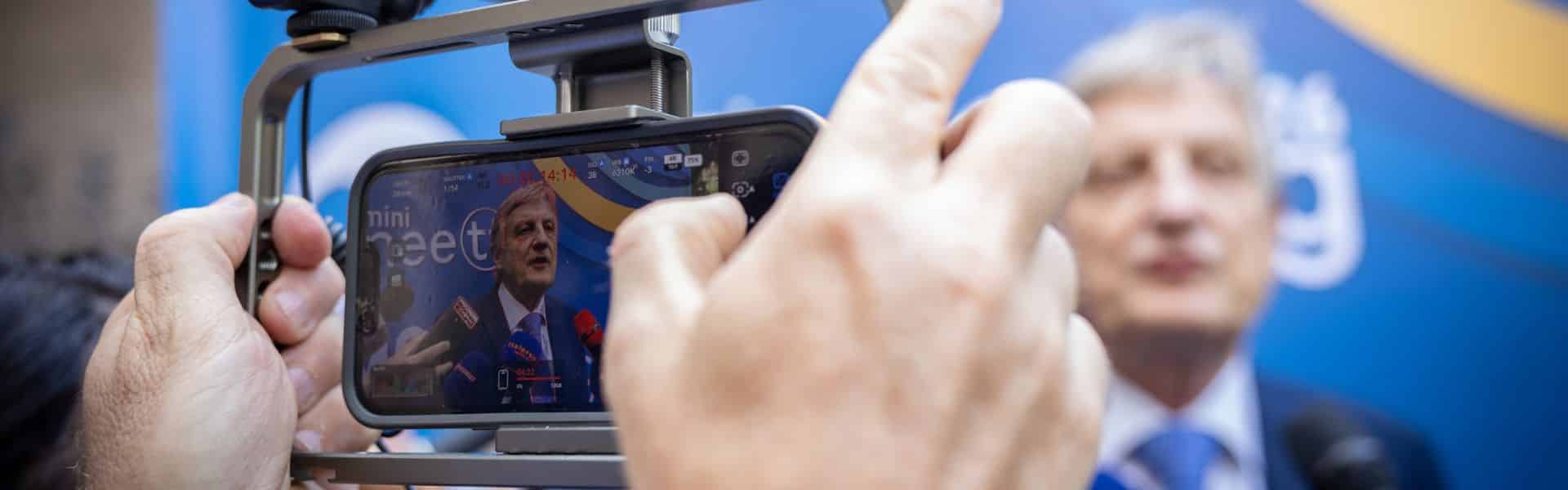
We wish to share this interview that Meeting president Bernhard Scholz gave to Enrico Castelli for the online news outlet ilSussidiario.net.
IlSussidiario.net, Sunday, July 12, MEETING RIMINI 2026 | Scholz: reconciliation, politics, hope, our challenge to the culture of conflict (Enrico Castelli)
Scholz explains this year’s Meeting: a line from Dante that puts back at the center the beauty and love that animate the universe. The Pope is coming to Rimini
At a time marked by wars, persecutions, political polarization, and growing confidence in technology’s ability to overcome every limit, the Rimini Meeting has chosen as its title a phrase that seems to go against the tide: The Love that moves the sun and the other stars.
The 47th edition, scheduled for August 21–26, 2026, will bring to the Rimini Fairgrounds 500 speakers, 150 events, 13 exhibitions, 13 shows, and 3,000 volunteers. But for president Bernhard Scholz, the point is not the numbers. “We need to rediscover that the principle behind the universe and our own existence is a principle of goodness, beauty, and love.” It is not a consolation, but a force that does not impose itself and that, when freely welcomed, can transform the person and, with it, social and political life.
President Scholz, “The Love that moves the sun and the other stars” is an almost provocative title. Today we see mostly conflict. Doesn’t it risk seeming out of touch with reality?
Certainly it is a title that seems to contradict the increasingly conflictual and embattled situation we find ourselves in. But that is exactly why we chose it. We need to rediscover that the principle behind the universe, which also shapes our own existence, is a principle of goodness, beauty, and love. This cannot be imposed: it must be freely welcomed by each person. Yet where it is welcomed, we see people capable of transforming the social, political, and cultural situation in truly surprising ways. The Meeting wants to bear witness to this possibility: facing even adverse situations with the certainty that love can change, renew, and regenerate the person.
So you’re not talking about a private feeling, but about a force that enters history. Is that right?
Yes. Think of the testimonies from Lebanon: under the bombing and amid the rubble, schools, nurseries, and shelters are being created; people are trying to get work going again, so they can live as decently as possible. Or think of the bishop from Nigeria, who will describe a truly atrocious persecution in his diocese. These are people who live through violence without falling into hatred or a desire for revenge. This is where Dante’s line shows its full power.
The Meeting will open with two women connected by a terrorist attack: one lost her brother, the other is the mother of one of the attackers. Why start from such a deep wound?
Because reconciliation is a source of peace. The story of these two women is remarkable: what happened not only did not prevent them from meeting, but in a sense became the very origin of their meeting. This testimony shows that nothing can prevent a person from meeting another, if they are willing to welcome that person in their dignity and in their desire for good — a desire that cannot be erased even by such painful events.
What do you mean by that? That evil does not entirely define a person?
Exactly. Welcoming the other in their dignity does not mean ignoring the pain or denying responsibility. It means not allowing evil to have the last word. Peace, then, is not born from a formula. It is born from an encounter that seemed impossible.
The Meeting will also welcome Pope Leo XIV, 44 years after the visit of John Paul II. What are you expecting?
Ever since the Holy Father accepted our invitation, great anticipation and great gratitude have grown among us. We know that many young people will come from Italy and from various parts of the world. In a sense, we would like to disappear: to give as much space as possible to his presence, his witness, and his words. We want to listen.
You have said that Magnifica humanitas, the encyclical on artificial intelligence, has broadened the Meeting’s perspective. Yet you consider it far more than a text about technology. Why?
Because it puts the dignity of the person and the greatness of humanity back at the center. And it speaks of limits not as something that stifles a person, but as a reality that opens them toward the infinite. This, to my mind, is one of its most important reflections. Today there is a temptation, and even an attempt, to overcome our limits through technology. The risk is tremendous: losing awareness of our true greatness, of a life destined to encounter the infinite and find its fulfillment there. The encyclical also contains decisive reflections on education, democracy, and the risk of technocratic oligarchies.
In other words, the more we try to become limitless, the more we risk losing the greatness of humanity.
Yes. The greatness of humanity does not consist in making oneself limitless through a tool. It consists in recognizing that the limit does not close the person in on themselves, but opens them up. Technology must be judged starting from the human person, not the human person starting from the possibilities of technology.
You call education “the single most important issue.” Yet in public debate, it rarely appears as the real emergency.
And yet it is the most decisive issue. The future of young people is, in a sense, also our vocation. If we lose our attention to children, teenagers, and young people, who must face a cultural situation far more complex and difficult than ours, we are not living up to what this moment demands of us. They live in a world where hope is no longer communicated almost automatically. They have to reclaim a genuine hope and resist the temptation to fall prey to a mass distraction that has now become impressively pervasive.
In other words, it’s not enough to protect them from these tools. We need to help them rediscover the questions.
Yes, they need to be accompanied in rediscovering themselves, in finding an attentiveness toward themselves and toward the world. It is within this attentiveness that the most important questions emerge — the ones that dwell in their hearts: the meaning of life, the significance of their own existence. The more these questions are forgotten or neglected, the more a person experiences a discomfort that becomes very hard to escape.
Many government and political figures will be at the Meeting. Aren’t you afraid the event will be used as a stage?
We have talked about politics at every Meeting, and we’re talking about it again this year. Complexity and polarization risk eroding trust in democracy, in public debate, and in politics itself. We try to engage with institutions and to make as transparent as possible the complexity they have to deal with today: public finance, mobility, energy, the pension system, the future of healthcare. These are hugely important issues, but also very difficult to understand and to govern.
So what you’re asking of politics is not the most effective slogan, but the courage not to oversimplify what isn’t simple.
Exactly. Transparency, for us, is an important hallmark of public debate. At the Meeting, it is very hard to reduce this complexity to two or three easy slogans, which may be appealing but are harmful. We want to make possible non-polarized political debates, in which differences remain, but people can still listen to each other and be measured against reality.
One of the events will be dedicated to Father Luigi Giussani. In what way does his charisma remain present at the Meeting?
The Meeting lives on this charisma: on the passion for human destiny that Father Giussani passed on to us, and which happens again and again. His interest in the whole of reality, in every one of its aspects; in beauty; in the possibility that everyone, even in the most difficult situations, can find their own destiny and a sense of fulfillment. This is what animates the Meeting and makes it possible to create, every year, an edition that is meaningful for the world. Without this passion of Giussani’s, without this passionate charisma for humanity, the Meeting would not be possible.
One hundred and thirty thousand square meters, 500 speakers, 150 events, and 3,000 volunteers. What are you hoping to achieve?
We want to welcome, in the best way possible, the people who come to meet one another and to encounter so many different realities from around the world. Even I am amazed every time by these figures. But interest in the Meeting is growing, and we have to respond with adequate facilities and a genuine capacity for hospitality.
And in the end, what is the Meeting’s contribution to the country?
Creating a place where people can meet freely; where non-polarized political debates are possible; where one can experience beauty. A place to encounter people from the past and the present who tell us that it is possible to live life as a great adventure, beautiful and fascinating. I think this is the true contribution we make to the country. And it is also a real support for Italy’s democratic life.