Who we are
Raphael and Divine Harmony. An Open Window on the Renaissance
Raphael is one of the greatest figures of the Renaissance.
The aim of this exhibition is to highlight how his art is the result of a particular conception of beauty—one marked by classical balance and a celebration of harmony—and how, because of these qualities, he is the one painter who can truly be called the interpreter of the so-called classical moment of the Renaissance.
Born in Urbino in 1483, Raphael began working alongside his father, the painter Giovanni Santi.
Around 1500, the young artist entered the workshop of one of the most renowned masters of the time: Perugino. It was with him that Raphael refined his mastery of drawing—one of the foundational elements of his poetics and style.
Even more significant in his eclectic formation was what he absorbed in Florence, where he came into direct contact with the works of Leonardo and Michelangelo.
During his Florentine period, Raphael showed a remarkable ability to synthesize—through his own distinct lens—the ideas suggested both by the leading figures of the Renaissance renewal and by classical tradition.
His move to Rome in 1508 marked a radical transformation.
There, under papal patronage—especially the enlightened and cultured Pope Julius II della Rovere—and immersed in the atmosphere of Rome, its history and ancient art (taken as a model for a new ideal of beauty), Raphael became the interpreter of a vision of beauty that was at once natural and ideal.
Through a deep respect for harmony, understood as both an aesthetic and ethical value, Raphael achieved a universal synthesis of classical antiquity and Christian tradition.
He celebrated this synthesis in grand, solemn compositions, where the human figure reigns over space in a position of absolute centrality—yet without being confined to a purely earthly dimension.
Exalted by a canon of beauty rooted in classical heritage—visible in the purity of the features, the nobility of gestures, and a certain reflective thoughtfulness in expressions—Raphael’s human figures also shine through the naturalistic realism of their individual traits.
Thus, his images of the Madonna and Child—eternal models for generations of artists—are admired both for their religious depth and their simplicity; his portraits of notable figures, while elevated to the status of universal types, never lose their intense individuality; his historical scenes, emblematic of ethically charged events, feature characters from both the past and his own present.
The ancient merges with the modern, the ideal with the natural, in a majestic vision where harmony dictates the laws of a splendid compositional order—one that reflects the greater order of creation.
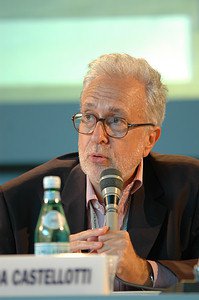
Marco Bona Castellotti
THIS EXHIBITION IS AVAILABLE IN A TRAVELING FORMAT. CLICK HERE FOR FULL DETAILS.