Who we are
ECCE HOMO
Antonello da Messina
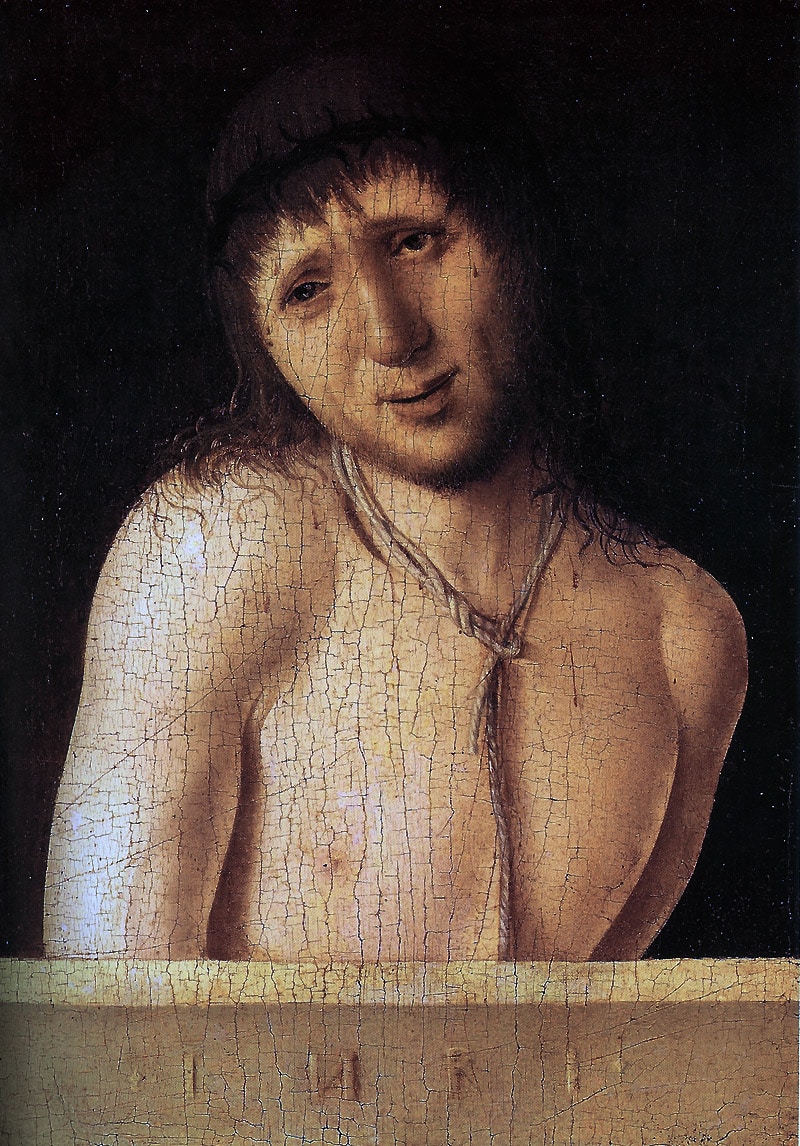
The Ecce Homo by Antonello da Messina, recently acquired by the Italian State, is a small-format panel — approximately 20 × 15 cm — that holds an extraordinary expressive power, capable of crossing the centuries and speaking today with surprising immediacy. Painted on both sides, it preserves two deeply connected images: on one side, Christ depicted in half-bust, his face marked by the Passion and his gaze turned directly toward the viewer, in a silent dialogue that erases all distance; on the other, a penitent Saint Jerome, immersed in a rocky and austere landscape, a place of solitude and meditation.
The work was intended for private devotion — an image to be kept, carried, contemplated in silence. Datable between 1460 and 1465, it belongs to a decisive phase of Antonello’s artistic journey, when his knowledge of Flemish painting merges with the Italian tradition, giving rise to a new language of luminous intensity, naturalness, and psychological depth. This is the earliest known version of the Ecce Homo, a subject destined to recur throughout the painter’s output, until it reached one of the highest expressions of the representation of Christ’s humanity in the Renaissance.
After a long period in private collections, this exceedingly rare panel is today returned to public enjoyment thanks to its acquisition by the Ministry of Culture. The exhibition recounts the context in which it was created, the history of the subject, and the story that brought it back to Italy — offering the public a precious opportunity: to admire a masterpiece that for a long time was kept from all eyes. An invitation to slow down, to observe carefully, and to let oneself be questioned by the silent power of a face that, more than five centuries on, retains intact its capacity to move all who encounter it.
Exhibition promoted by the Ministry of Culture